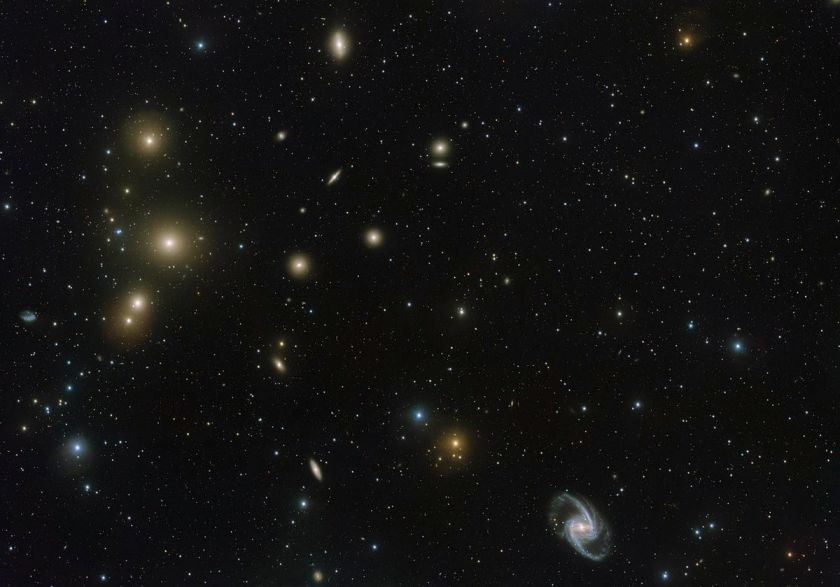
Lately I’ve been reading a paper about large clusters of galaxies “located” far back into a younger universe, at a redshift of z ≈1.27. This means that when the light first left the galaxy cluster, the universe was half it’s size, at least if I’m remembering it correctly. Cosmology is weird.
So basically, this paper looks at two different clusters, and then basically applies a evolutionary model to see how it would look today, compared to similar galaxy clusters located at smaller redshifts. That’s the gist of the paper, I think. The devil is always in the details though. The first thing I wanted to do is work with some data. And then I can reread parts of the paper and the appendix and try to piece together what’s going on.
I found a FITS file on NASA/IPAC Extragalactic Database (NED) containing one of the two galaxy clusters the study was looking at, Lynx E. I was able to make some pretty good looking pictures from the data, and show two pictures below with the more “grainy” picture on the right being a different color scale. This is useful because it reveals more galaxies then there would have been before.
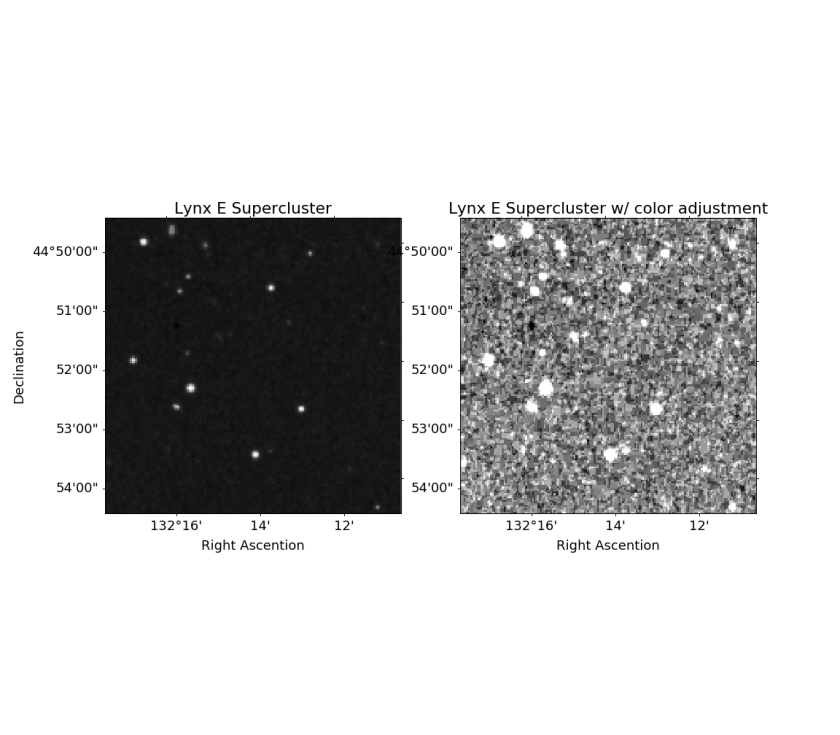
I’m going to try something different. It took me a while to create these plots by hand, because I had to visually look at a histogram, and sort of “guess” the color scale. I’m going to try to automate this by writing something called a “script”. There’s a task I want to get done, so I run a script to get the task done. Usually it’s done on tasks that are repeatable. I want to create the same plots by for Lynx W instead of Lynx E.
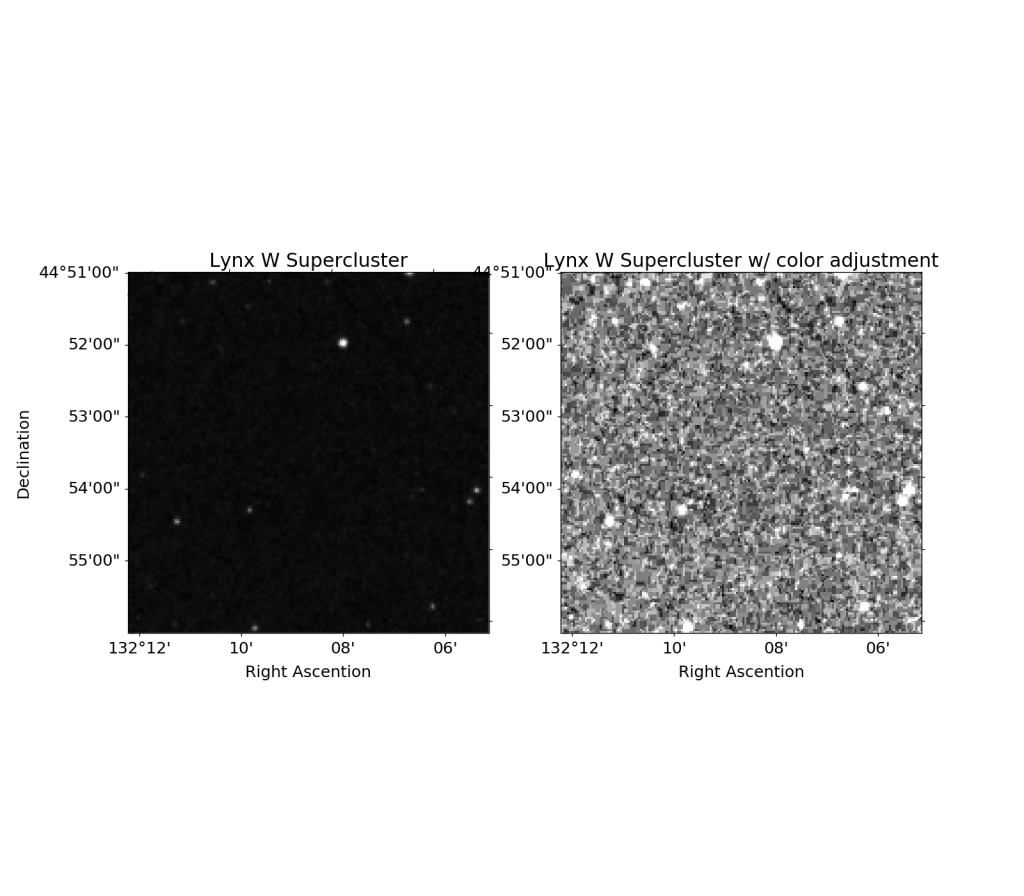
So the script ended up working out. In the terminal, you just have to run it using the python command, and it asks for a fits file path name. It should work on all fits files, but I’ve only tested it on HST data. It’s a little messy, like on the y-axis, but it can be improved on fairly quickly.
In my next post, I’m going to talk a little bit about Gaussians since they keep showing up, unsurprisingly. I’ll also see if I can get my hands on those evolutionary models or tracks. Maybe that’s not even a thing, but I won’t know until I read a little bit more.

 Cosmalo's Blog